The Quick Answer
Pocketed coils, also called individually wrapped or fabric-encased coils, are steel springs each sealed in its own fabric pocket. Because each coil moves on its own, a pocketed coil unit responds to the shape of your body, transfers less motion than connected springs, and lets air move freely through the mattress.
In a latex hybrid, the latex comfort layer handles pressure relief while the pocketed coils provide most of the support, bounce and edge strength. The three specs worth knowing are gauge (wire thickness), count (number of coils) and zoning (firmer or softer areas). Of these, gauge and design matter more than raw count.
How Pocketed Coils Work
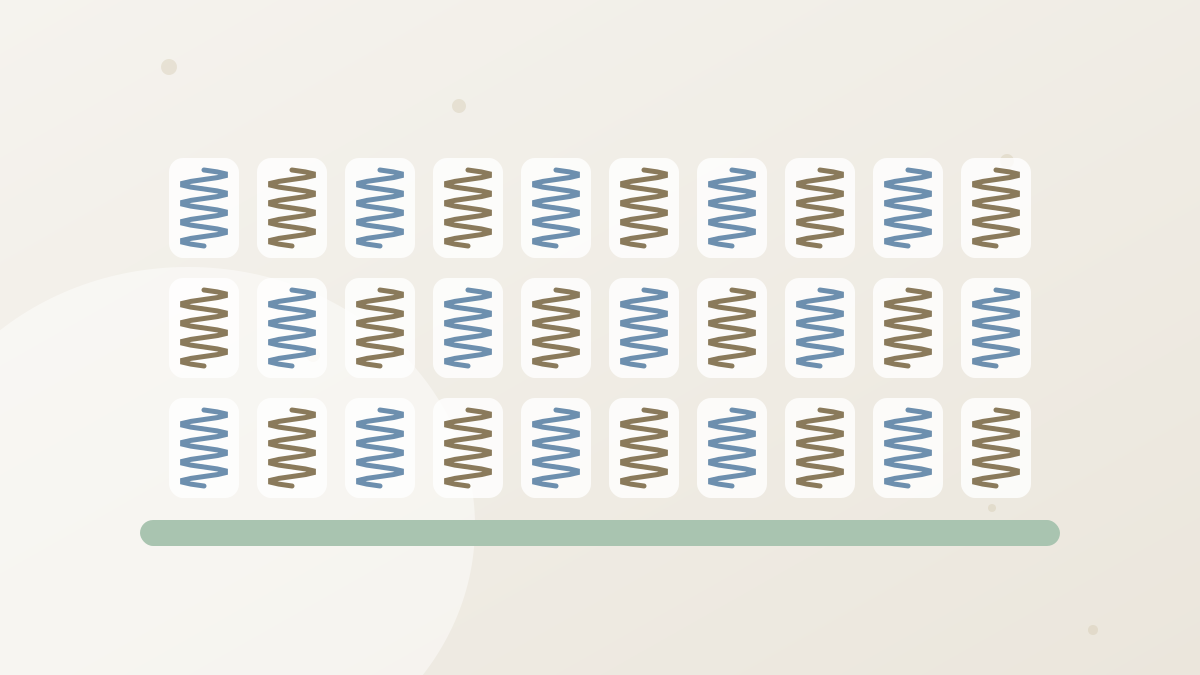
Each coil is a spiral of tempered steel wire placed inside a fabric sleeve. The sleeves are joined together in rows, then the rows are joined to form a full coil unit. Because the coils aren't wired to each other, pressing on one coil doesn't pull its neighbors down with it.
That independence gives pocketed coils three advantages over older connected innersprings:
- Better contouring. Each part of your body is supported by the coils directly beneath it.
- Less motion transfer. A partner rolling over moves fewer coils on your side.
- Better airflow. The open spaces between coils let heat and moisture escape.
The fabric used for the pockets is usually a non-woven material. Eco Terra describes its "Quantum" coils as encased in food-grade non-woven polypropylene and made from upcycled, heat-treated steel.
Pocketed Coils vs Other Coil Types
Table: Common Coil Types Compared | Coil Type | How It's Built | Motion Isolation | Contouring | Common In | |---|---|---|---|---| | Pocketed (wrapped) | Each coil in its own fabric pocket | Good | Good | Hybrids, premium innersprings | | Bonnell | Hourglass coils laced together | Poor | Limited | Budget innersprings | | Offset | Hourglass coils with flat tops, hinged | Fair | Fair | Mid-range innersprings | | Continuous | One long wire formed into rows | Poor | Limited | Budget innersprings | | Micro-coils | Very small pocketed coils | Good | Very good | Comfort layers in some hybrids |
Nearly every modern latex hybrid uses pocketed coils for the support core. Some premium designs add a layer of micro-coils near the surface for extra contouring.
Coil Gauge: Wire Thickness
Gauge describes the thickness of the steel wire. The scale runs backward: a lower gauge number means thicker wire. Mattress coils typically range from about 12 or 13 gauge, which is thick and firm, to about 17 gauge, which is thin and flexible.
Table: Coil Gauge Guide | Gauge | Wire Thickness | Typical Feel | Common Use | |---|---|---|---| | 12–13 | Thickest | Very firm, very durable | Edge reinforcement, heavy-duty support | | 14–15 | Thick | Firm, supportive | Main support cores | | 16 | Medium | Responsive, flexible | Support cores, perimeters, softer zones | | 17+ | Thinnest | Soft, very flexible | Comfort coils, micro-coils |
Thicker wire is generally firmer and more durable, which matters more for heavier sleepers. Thinner wire is more flexible and responsive. Gauge isn't the whole story, though. Coil height, diameter, the number of turns and how the steel was tempered all affect firmness too.
The Eco Terra uses 15-gauge coils in the center and 16-gauge coils around the perimeter. Eco Terra pairs the perimeter coils with its edge-support design, so the bed's sides feel stable when you sit or sleep near the edge.
Coil Count: Does More Mean Better?
Coil count is the number of coils in a given mattress size, usually quoted for a queen. Counts vary widely: many pocketed coil queens fall somewhere between roughly 600 and well over 1,000 coils, and designs with micro-coil layers can exceed 2,000.
A higher count can mean finer, more responsive support, but count alone doesn't tell you much. A mattress with fewer, thicker, well-tempered coils can support better than one with more thin coils. Count is most useful when comparing mattresses of the same size and coil type from the same brand.
Some examples of what brands state:
- Avocado Green: up to 1,379 wrapped coils, depending on size, in a 7-zone unit
- Brentwood Home Hybrid Latex: up to 975 8-inch pocketed coils
- Silk & Snow Organic: 999 coils in a queen
- Leesa Natural Hybrid: 1,032 reinforced springs
Coil Height
Coils in latex hybrids are usually 6 to 8 inches tall. Taller coils give more travel before you reach the base, which can feel more cushioned and help heavier sleepers. Shorter coils keep the overall mattress height down.
Coil height also affects total mattress height. A hybrid with 8-inch coils and 3 to 4 inches of latex plus a cover typically lands around 11 to 13 inches tall. The Eco Terra measures 11 inches overall.
Zoned Coils
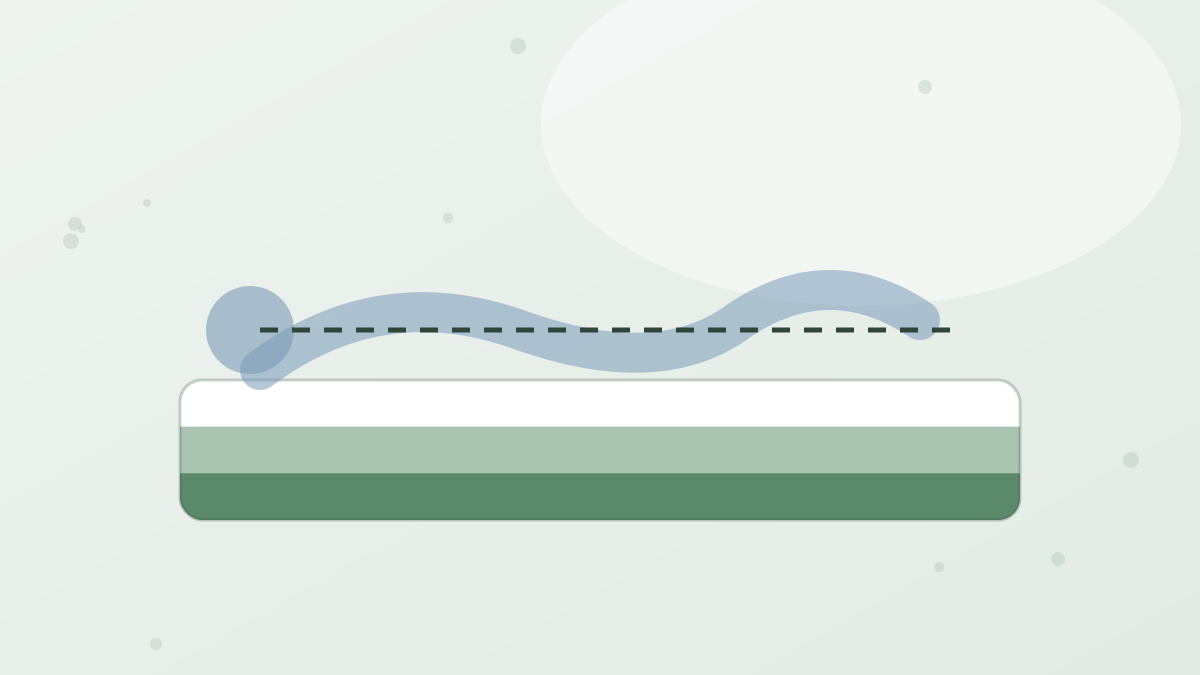
Zoning means coils in different areas of the mattress have different firmness. A common setup is softer coils under the shoulders, firmer coils under the hips and lower back, and medium coils under the legs.
Zoning can help:
- Side sleepers sink their shoulders a little more while keeping the hips level
- Back sleepers get extra lumbar support
- Heavier sleepers prevent hip sinkage
Examples include Avocado's 7-zone coils, Nolah's three-zone HDMax coils and WinkBeds' zoned coils in the EcoCloud. Zoning adds cost and isn't essential. Many sleepers do well on a non-zoned unit with the right firmness, which is the approach Eco Terra takes.
Edge Support
The edge of a mattress takes a lot of stress when you sit on it to dress or get in and out of bed. Without reinforcement, edges can compress and make the usable sleep surface smaller.
Brands reinforce edges with thicker-gauge perimeter coils, extra-firm coils, foam encasements or steel border rods. Latex hybrids generally have stronger edges than all-latex or all-foam mattresses because coils can be reinforced. Eco Terra uses a dedicated perimeter coil row for edge support.
Durability of Pocketed Coils
Quality pocketed coils are very durable. Tempered steel resists losing its spring, and fabric encasement protects the coils from rubbing against each other. Heat-treating, which Eco Terra mentions for its coils, helps the steel hold its shape.
Coils are only as durable as their support, though. A weak foundation lets the whole coil unit flex and sag. Eco Terra's warranty requires a rigid foundation and, without metal center support, at least five hardwood 1x4 slats. Our foundation guide explains what to use.
Upcycled and Recycled Steel

Some natural mattress brands use recycled or upcycled steel for their coils, which reduces the need for newly mined material. Eco Terra describes its coils as upcycled steel. Saatva's Latex Hybrid and Nolah's Natural also mention recycled steel coils.
Steel is also widely recyclable at the end of a mattress's life, which is one reason hybrids can be easier to recycle than you might expect. Our mattress disposal guide covers recycling options.
Pocketed Coils and Motion Transfer
Pocketed coils transfer less motion than connected springs, but latex hybrids still transfer more than all-latex or memory foam beds. Latex is springy, and coils add bounce, so some movement travels.
Most couples find it moderate rather than disruptive. If one of you is a very light sleeper, an all-latex bed or a larger mattress size can help. Our best latex mattress for couples guide compares options.
Coils and Your Foundation
Pocketed coils are designed to sit on a firm, flat, supportive surface. If the base underneath flexes or has wide gaps, the coil unit can bow and lose its even support, which feels like sagging even when the coils themselves are fine.
Good options for a latex hybrid include a solid platform with ventilation, a slatted foundation with slats close together, or a compatible adjustable base. Eco Terra's warranty requires a rigid foundation with center support for queens and kings, and at least five hardwood 1x4 slats if there's no metal center support. Eco Terra also sells its own wood foundation and adjustable bases. Our Eco Terra bed bases guide compares them.
How Coils Affect the Feel of Latex
The coil unit changes how the latex on top feels. Over coils, a latex layer feels springier and a little softer at the surface, because the coils compress along with the latex. Over a dense latex core, the same latex feels firmer and more grounded.
That's why a medium latex comfort layer in a hybrid often feels slightly different from the same firmness in an all-latex bed. If you're comparing the two designs, our hybrid vs all-latex guide explains the differences in feel, motion and cooling.
Specs Worth Asking About
Table: Pocketed Coil Questions to Ask | Question | Why It Matters | |---|---| | What gauge is the steel? | Thicker wire supports more and lasts longer | | Are the edges reinforced? | Stronger edges add usable space | | Are the coils zoned? | Zoning can help alignment | | How tall are the coils? | Affects cushioning and overall height | | Is the steel tempered or heat-treated? | Helps coils keep their spring | | What foundation is required? | Protects support and warranty |
Where the Eco Terra Fits
The Eco Terra Hybrid Latex uses fabric-encased, heat-treated upcycled steel coils, with 15-gauge center coils for support and 16-gauge perimeter coils for edge support. On top sits 3 inches of GOLS-certified organic latex. It isn't zoned, but it offers two firmness options, Medium and Medium-Firm, so you can match the latex feel to your sleep position.
That combination gives it the airflow, bounce and edge stability that latex hybrids are known for, at about $1,014 for a queen in November 2026. Our latex hybrid guide explains how the layers work together.
Want organic latex over sturdy wrapped coils? Check today's Eco Terra price on the official site.
Pocketed Coils FAQ
What are pocketed coils?
Steel springs each sealed in their own fabric pocket, so they move independently to support your body and reduce motion transfer.
What coil gauge is best?
For most sleepers, 14- to 16-gauge works well. Heavier sleepers often benefit from thicker, lower-gauge coils.
Does a higher coil count mean a better mattress?
Not necessarily. Gauge, coil design and tempering matter as much or more. Compare counts only within the same size and type.
Are pocketed coils better than innersprings?
Pocketed coils are a type of innerspring. They contour better and transfer less motion than connected designs like Bonnell coils.
What coils does the Eco Terra use?
Fabric-encased upcycled steel coils, 15-gauge in the center and 16-gauge around the perimeter for edge support.