The Short Answer
A latex hybrid mattress combines a latex comfort layer with a pocketed coil support core. The latex on top relieves pressure and feels responsive. The coils underneath add support, bounce, airflow and firm edges. Natural versions wrap it all in a wool fire barrier and a cotton cover.
The result is a mattress that sleeps cooler than most foam beds, feels livelier than all-latex, and usually costs less than an all-latex mattress with the same comfort.
The Layers of a Latex Hybrid
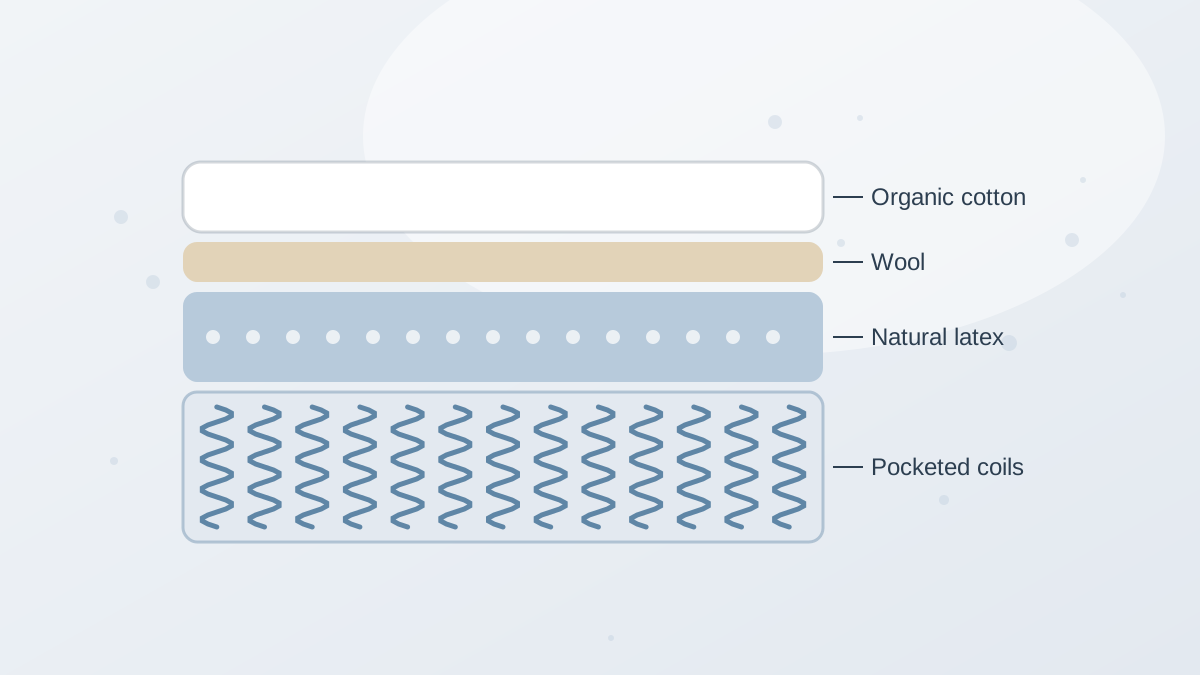
Most natural latex hybrids are built in four parts, from top to bottom.
Cover. Usually organic cotton, sometimes quilted with wool. It's the surface you sleep on and affects breathability.
Fire barrier. Every US mattress must meet federal flammability rules. Natural hybrids often use wool, which resists flame naturally. Budget beds may use fiberglass or chemical treatments instead.
Latex comfort layer. Usually 2 to 4 inches of natural latex. This is where pressure relief happens.
Coil support core. Individually wrapped steel coils, often 6 to 8 inches tall, sometimes zoned and often reinforced around the edge.
The Eco Terra Hybrid Latex follows this pattern: a GOTS organic cotton cover, a GOTS organic wool fire barrier, a 3-inch seamless GOLS organic latex layer, and fabric-encased upcycled steel coils, for an 11-inch mattress.
What the Latex Layer Does
The latex layer cushions your shoulders, hips and other pressure points, then pushes back to keep you supported. Because latex is elastic, it responds instantly when you move, so you don't feel stuck.
Thickness matters. A 2-inch layer gives a firmer, more coil-forward feel. A 3-inch layer balances cushioning and support. A 4-inch layer gives deeper pressure relief, often preferred by side sleepers.
Firmness matters too. Some brands publish ILD, a measure of latex firmness. Eco Terra rates its Medium at ILD 24–26 and its Medium-Firm at ILD 29–31. Our ILD guide explains the scale.
What the Coils Do
The coils handle most of the support. Individually wrapped, or pocketed, coils move independently, so they respond to each part of your body rather than sagging as one unit. That's also why they transfer less motion than old connected innersprings.
Coils also create open space inside the mattress, which lets heat and moisture escape. And because the perimeter can be reinforced with dedicated edge coils, latex hybrids usually have sturdier edges than all-latex or all-foam beds.
Look at three details:
- Gauge. Lower numbers mean thicker steel. Eco Terra uses 15-gauge center coils and 16-gauge perimeter coils.
- Zoning. Some brands vary coil firmness under the shoulders and hips.
- Edge reinforcement. Firmer perimeter coils help when you sit or sleep near the edge.
Our pocketed coils guide goes deeper.
How a Latex Hybrid Feels
Most people describe latex hybrids as buoyant and lively. You rest on top of the surface with gentle contouring, and the coils add a springy push-back. It's easy to change positions, and the edges feel stable.
That feel sits between two extremes. All-latex beds feel denser and more grounded. Memory foam hybrids feel slower and more enveloping. If you've slept on a traditional innerspring and liked its bounce but wanted more pressure relief, a latex hybrid often feels familiar in a good way.
Latex Hybrid vs All-Latex vs Foam Hybrid
Table: How Latex Hybrids Compare | Trait | Latex Hybrid | All-Latex | Memory Foam Hybrid | |---|---|---|---| | Feel | Buoyant, springy | Dense, buoyant | Contouring, slower | | Cooling | Very good | Good | Fair to good | | Motion isolation | Moderate | Strong | Good | | Edge support | Strong | Softer | Good | | Durability | Very good | Excellent | Good | | Weight (queen) | Heavy | Often heavier | Moderate | | Typical queen price | $1,000–$2,700 | $1,500–$3,000+ | $1,000–$2,500 |
Our hybrid vs all-latex guide and latex vs memory foam guide cover each comparison in depth.
Benefits of a Latex Hybrid
- Cool sleep. Coils move air; latex doesn't trap heat the way dense foam can.
- Responsive feel. Easy movement and position changes.
- Strong edges. Reinforced perimeters make the full surface usable.
- Durable support. Natural latex resists impressions; quality coils keep their shape.
- Lower cost than all-latex. Less latex means a lower price for similar comfort.
- Easier to handle. Usually lighter than a comparable all-latex bed.
Drawbacks to Know
- Motion transfer. Bounce means some movement travels. Very light sleepers may notice.
- Still heavy. A queen Eco Terra weighs about 100 pounds.
- Less latex. If you want latex top to bottom, a hybrid won't give you that.
- Fixed layers. Most hybrids can't be unzipped and rearranged like some all-latex beds.
Not All "Latex Hybrids" Are the Same
The term "latex hybrid" covers a wide range of designs, and some contain much less latex than others. Some put a thin latex layer over several inches of polyurethane foam before the coils. Others use blended or synthetic latex.
If you want a natural latex hybrid, check:
- Latex thickness. At least 2 to 3 inches is typical for a true latex comfort feel.
- Latex type. Natural or certified organic (GOLS), not blended.
- Foam content. Look for "no polyurethane foam" if you want a foam-free bed.
- Fire barrier. Wool rather than fiberglass, if that matters to you.
- Law label. It lists filling materials by weight. Eco Terra's full-size label, for example, shows 73 percent natural latex.
Our fiberglass-free mattress guide explains fire barriers in more detail.
Latex Hybrid Height and Weight
Most latex hybrids are 10 to 13 inches tall. Taller mattresses usually have thicker comfort layers or taller coils, which can mean more cushioning and support for heavier sleepers. Shorter ones are easier to move and fit lower-profile frames and bunks.
Height affects practical things too. A taller mattress may need deep-pocket sheets, and on a tall frame it can make getting in and out of bed harder. The Eco Terra is 11 inches, a middle height that works with standard sheets and most bed frames.
Weight is the other practical consideration. Latex is dense, so even hybrids are heavy. Eco Terra lists its weights by size: 59 pounds for a twin, 100 for a queen and 127 for a king. Plan for two people when moving one. Our mattress height guide explains how height affects comfort and fit.
Zoned Latex Hybrids
Some latex hybrids add zoning, meaning the latex or coils are firmer in some areas and softer in others. A common setup is softer under the shoulders, firmer under the hips and lower back, and softer again under the legs.
Zoning can help side sleepers sink their shoulders a little more while keeping the hips level. It can also help back sleepers who want extra lumbar support. Examples include the Saatva Latex Hybrid's 5-zone latex, the Avocado Green's 7-zone coils and the Nolah Natural's three-zone coils.
Zoning isn't essential, though. A well-chosen firmness without zoning works well for many sleepers, and non-zoned beds are often less expensive. The Eco Terra isn't zoned, but it uses a separate 16-gauge coil around the edge for edge support.
Who Should Choose a Latex Hybrid?

Table: Latex Hybrid Fit by Sleeper | Sleeper | Fit | Notes | |---|---|---| | Hot sleepers | Strong | Coils and natural covers move heat | | Combination sleepers | Strong | Responsive and easy to move on | | Back sleepers | Strong | Medium-firm options keep the spine level | | Side sleepers | Good | Choose medium or a thicker latex layer | | Couples | Good | Strong edges; moderate motion transfer | | Very light sleepers | Fair | Consider all-latex for motion isolation | | Heavier sleepers | Strong | Look for thicker-gauge coils and medium-firm |
What a Latex Hybrid Costs
Natural latex hybrids usually cost $1,000 to $2,700 for a queen, depending on latex thickness, certifications and brand. The Eco Terra queen costs $1,014 in Medium and $1,019 in Medium-Firm in November 2026, which puts it at the lower end for a certified organic latex hybrid with no polyurethane foam. Our best latex hybrid mattress guide compares the top options.
Want an organic latex hybrid without a premium price? Check today's Eco Terra price on the official site.
Setting Up and Caring for a Latex Hybrid
Most latex hybrids ship compressed in a box and expand within hours. They need a supportive base: a platform, a slatted foundation with close slat spacing, or a compatible adjustable base. Eco Terra's warranty, for instance, requires a rigid foundation and at least five hardwood 1x4 slats if there's no metal center support.
Rotate head to foot occasionally to even out wear, and use a breathable protector. Our latex mattress setup guide walks through unboxing and the first few weeks.
Common Questions Shoppers Ask Before Buying
Will a latex hybrid feel too firm? Latex can feel firmer than memory foam at the same label. If you're a side sleeper or under about 130 pounds, choose a medium, a thicker comfort layer, or plan to add a soft topper.
Will you feel the coils? Not with a quality latex layer of 2 inches or more and a padded cover. What you'll notice is a gentle, springy lift rather than individual coils.
Does it need breaking in? Most latex hybrids feel slightly firmer at first and settle over the first few weeks. That's normal. Our break-in guide explains what changes.
Can it go on your existing base? Usually, if the base is rigid with close slat spacing or center support. Eco Terra also says its hybrid works with standard adjustable bases.
Is it worth the price over a foam hybrid? If you value cooler sleep, natural materials and durability, many shoppers find it is. If you prefer a deep, slow-sinking feel, a foam hybrid may suit you better.
Latex Hybrid Mattress FAQ
What is a latex hybrid mattress?
A mattress with a latex comfort layer over a pocketed coil support core, usually wrapped in a natural cover.
Is a latex hybrid better than all-latex?
Not better, just different. Hybrids are cooler, bouncier and cheaper; all-latex isolates motion better and contains more latex.
How long does a latex hybrid last?
Quality latex hybrids are among the more durable mattresses. Warranties of 15 years or longer are common; Eco Terra's is 15 years non-prorated.
Do latex hybrids contain foam?
Some do. Natural latex hybrids like the Eco Terra use no polyurethane foam, but others add foam layers. Check the material list.
Is a latex hybrid good for side sleepers?
Yes, in a medium feel or with a thicker latex layer. Very firm hybrids may feel too hard at the shoulder.